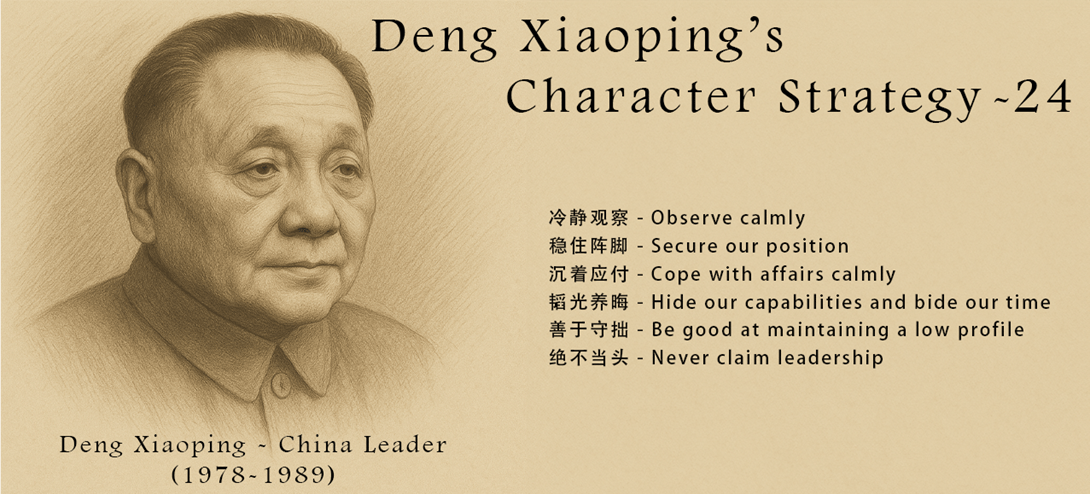
Deng Xiaoping’s 24-Character Strategy, which fueled China’s rise to economic greatness, offers a timeless framework for strategic success in our workplace. By embracing its principles of patience, humility, and focus, we can enhance personal growth, foster collaboration, and drive organizational excellence.
In the late 1970s, Deng Xiaoping, a transformative Chinese leader and the architect of China’s economic, launched economic reforms that drove China to its current status as a global economic center, the world’s second-largest economy, and a leader in manufacturing and tech innovation. A key element of this success was his 24-Character Strategy, introduced in 1989 as a foreign policy guideline. The strategy’s spirit of patience, focus on internal capability, and disciplined humility offers a powerful lens for organizational success. This strategy can be distilled into six principles:
- 冷静观察 – Observe calmly
- 稳住阵脚 – Secure our position
- 沉着应付 – Cope with affairs calmly
- 韬光养晦 – Hide our capacities and bide our time
- 善于守拙 – Be good at maintaining a low profile
- 绝不当头 – Never claim leadership
These ideas guided China’s cautious yet strategic rise, emphasizing patience and internal growth over premature global assertiveness. Today, this framework offers valuable lessons for organizations, showing how deliberate, principled strategies can drive long-term success. China’s economic achievements, from its staggering GDP growth to its dominance in global trade and initiatives like the Belt and Road, highlight the power of strategic patience. By focusing on internal development, China built a foundation for enduring prosperity. Similarly, in our workplace, adopting a thoughtful, long-term approach can help us overcome obstacles, foster innovation, and achieve sustainable results. The 24-Character Strategy provides a universal blueprint for strategic thinking that we can adapt to enhance personal growth, workplace harmony, and organizational strength. In this article we will examine how we can utilize each of the six principles in our daily work.
冷静观察 – Observe calmly
This means pausing to fully understand a situation before acting. By assessing challenges thoughtfully, you improve decision-making and avoid costly errors, boosting your career longevity. In practice, this could involve analyzing a project delay before adjusting timelines. Picture a project manager who identifies the root cause of a setback and resolves it effectively, maintaining team momentum. Employees who master calm observation enjoy clear situational awareness, reduced stress, and better decision quality.
稳住阵脚 – Secure our position
Ensure our work is consistently reliable and high-quality. This builds trust and credibility, strengthening our professional standing. Practically, this might mean reviewing deliverables thoroughly before submission. Imagine an employee whose consistent excellence earns them a reputation as a dependable team member, opening doors for advancement. This is an absolute career longevity and resilience against external shocks.
沉着应付 – Cope with affairs calmly
Workplace challenges are inevitable; therefore, handle them with composure to reduce stress and resolve conflicts effectively. What distinguishes high performers is composed problem-solving. This could mean stepping back during a tense discussion to find a balanced solution. Consider a team leader who stays calm during a disagreement, guiding the group to a constructive outcome and reinforcing team unity.
韬光养晦 – Hide our capacities and bide our time
Focus on results rather than self-promotion, letting work speak for itself. This humility earns respect and fosters steady growth. In practice, avoid boasting about achievements and prioritize improvement. Think of a skilled employee who remains modest, collaborates well, and advances through merit alone.
善于守拙 – Be good at maintaining a low profile
Concentrate on tasks without seeking unnecessary attention. This minimizes distractions and builds a reputation for reliability. For instance, deliver strong results quietly rather than chasing recognition. Picture a team member whose consistent performance earns organic respect and opportunities. Employees who elevate the team rather than the ego foster a culture of trust and cooperation.
绝不当头 – Never claim leadership
Foster collaboration over dominance by empowering others and sharing credit. This enhances teamwork and creates a positive environment. Practically, encourage colleagues to lead when appropriate. Envision a manager who delegates project ownership, cultivating a collaborative culture that benefits everyone.
Deng Xiaoping’s 24-Character Strategy proves that patience, humility, and focus can yield extraordinary outcomes. Deng’s philosophy reminds us to think long-term, adapt wisely, and build influence by delivering value consistently especially in complex, politically sensitive, or competitive workplaces. By integrating these principles into our work, we can enhance our careers, strengthen our workplace, and contribute to our organization’s success. Let us take a moment to consider how we might apply this approach in our roles, whether in managing projects, collaborating with hybrid teams, or pursuing career goals.

