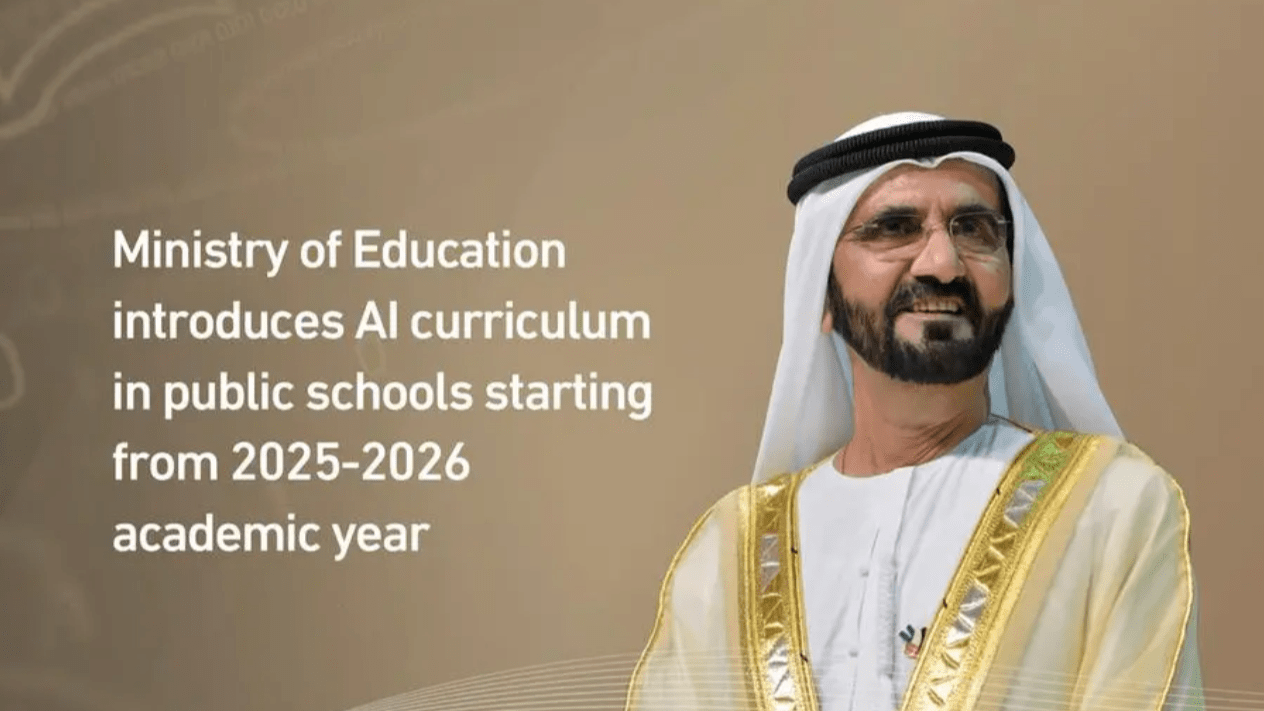
On Sunday, May 4, 2025, H.H Sheikh Mohammed bin Rashid Al Maktoum, Vice-President and Prime Minister of the UAE, announced a groundbreaking educational initiative as Artificial Intelligence (AI) will become a compulsory subject across all stages of government education in the UAE, from kindergarten to grade 12, starting from the next academic year. This decisive move positions the UAE as only the second country globally, after China, to mandate AI education across all K-12 grades. The announcement comes at a critical stage when nations worldwide are racing to prepare their youth for an AI-driven future, with the United States actively assessing similar nationwide implementation.
The UAE’s decision to integrate AI education into its national curriculum isn’t merely an educational reform, it’s a strategic investment in the nation’s future competitiveness. In today’s rapidly evolving technological landscape, countries that develop AI literacy early will likely emerge as leaders in innovation, economic growth, and global influence. The comprehensive AI curriculum spans seven key areas: (1) foundational concepts, (2) data and algorithms, (3) software use, (4) ethical awareness, (5) real-world applications, (6) innovation and project design, and (7) policies and community engagement. This holistic approach ensures students develop not just technical skills but also critical thinking about AI’s broader implications.
Our responsibility is to equip our children for a time unlike ours, with conditions different from ours, and with new skills and capabilities that ensure the continued momentum of development and progress in our nation for decades to come
Sheikh Mohammed stated in his announcement.
International cases offer valuable lessons as the UAE embarks on nationwide AI education. By examining how other world leaders have introduced AI into their school systems, most notably China’s comprehensive rollout and the United States’ emerging pilot programs, we can identify proven strategies, anticipate challenges, and tailor an approach that accelerates our own national ambitions.
Learning from China’s Success Story
China’s early adoption of AI education offers compelling evidence of the benefits of such initiatives. Since launching its nationwide AI curriculum in 2018, China has witnessed remarkable outcomes that the UAE can emulate and build upon. The Chinese government’s Next Generation Artificial Intelligence Development Plan, issued in 2017, established the foundation for universal AI education with the goal of becoming “the world’s primary AI innovation center” by 2030. Following this vision, China implemented a multi-layer AI education program that spans primary and secondary education. The results have been impressive. China has seen a significant rise in AI patents, student participation in AI competitions, and the emergence of innovation hubs centered around artificial intelligence. The country’s robust public-private partnership model has enabled schools to access cutting-edge resources, with AI companies functioning as “technical partners” for educational institutions. Most importantly, China’s early investment in AI education has created a robust talent pipeline that continues to fuel its technological advancement and economic growth. By introducing AI concepts from an early age, China has demystified this complex technology for an entire generation, sparking curiosity and creativity that drives innovation.
The United States: A Different Approach
While the United States has not yet implemented a nationwide AI curriculum mandate, it is actively exploring various approaches to AI education. In April 2025, the White House issued an executive order on “Advancing Artificial Intelligence Education for American Youth,” establishing a Task Force on Artificial Intelligence Education to coordinate federal efforts. The US approach emphasizes public-private partnerships, teacher training, and the development of AI resources for K-12 education. Various pilot programs across different states are testing different models of AI integration, with a focus on both technical skills and ethical considerations. The ongoing policy debates in the US center around questions of standardization, teacher preparedness, and the balance between technical skills and critical thinking. Unlike China’s centralized approach, the US model allows for more local experimentation but may result in uneven implementation across different regions.
The UAE’s decision to mandate AI education aligns perfectly with its broader national strategy. The UAE National AI Strategy 2031 aims to position the country as a global leader in artificial intelligence, with targets for AI’s contribution to GDP, government efficiency, and talent development. By introducing AI education at all levels, the UAE is laying the groundwork for its digital economy targets and ensuring that future generations will be equipped to contribute to and benefit from technological advancement. This educational initiative complements other national efforts, including investments in AI research, startup ecosystems, and digital infrastructure.
Sarah Al Amiri, Minister of Education, described the integration of AI in education as a “national imperative” that “supports economic growth, fosters sustainable development and significantly enhances individual capabilities.” However, she also acknowledged the importance of developing “the capacity required to use AI wisely, effectively and ethically.“
Addressing the Concerns
Critics of early AI education often express concern that it could reduce time spent on foundational logical-reasoning skills or lead to excessive screen time. These are valid considerations that require thoughtful responses. However, the UAE’s approach addresses these concerns by integrating AI education within the broader curriculum rather than treating it as an isolated subject. The tailored units for each age group ensure age-appropriate learning, with four-year-olds engaging in visual and interactive activities to discover AI through play. Furthermore, the curriculum’s emphasis on ethical awareness and critical thinking helps students develop an AI specific understanding of its capabilities and limitations. By teaching students to question and evaluate AI systems, the curriculum actually enhances rather than diminishes logical reasoning skills. The balanced approach also includes practical, hands-on learning experiences that go beyond screen-based activities. In cycle two, for example, students design their own AI systems while learning about bias and algorithms, combining technical skills with critical analysis.
Forward-Looking Benefits
The long-term benefits of the UAE’s AI education initiative extend far beyond the classroom. By creating a generation of AI-literate citizens, the UAE is:
- Enhancing workforce readiness for an increasingly automated economy
- Accelerating economic diversification beyond traditional sectors
- Fostering home-grown research and innovation in AI technologies
- Strengthening global competitiveness in high-tech industries
- Building capacity for ethical AI governance and policy development
The curriculum’s focus on real-world applications and project design ensures that students can connect theoretical knowledge to practical solutions, preparing them for higher education and the world of work.
A Model for Other Nations
The UAE’s bold move to make AI education mandatory across all government schools offers valuable lessons for other countries considering similar initiatives. By combining elements of China’s systematic approach with attention to ethical considerations and critical thinking, the UAE is creating a model that balances technical skills with humanistic values. As AI continues to transform industries and societies worldwide, educational systems must evolve to prepare students for this new reality. The UAE’s comprehensive curriculum, with its emphasis on both technical proficiency and ethical awareness, provides a promising template for AI education in the 21st century.
Do you believe introducing AI education at all grade levels is the right approach for preparing future generations? Or should education systems focus more on traditional skills before introducing advanced technologies? The answers to these questions will shape not just educational policies but the future of work, innovation, and global competitiveness in the AI era.

