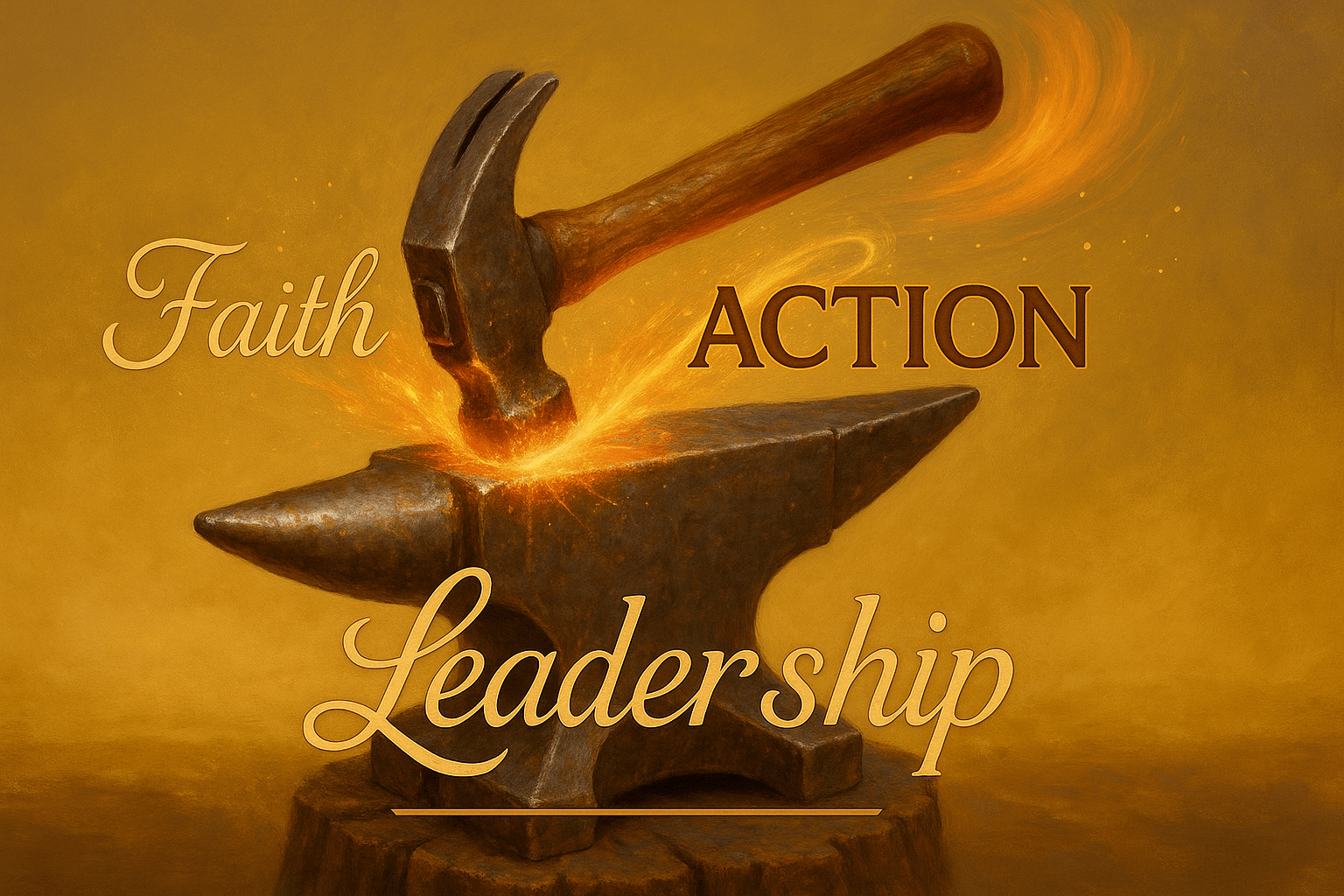
True leadership is not a performance. It is the harmony between what we believe and how we act. When conviction guides behavior, teams do more than achieve results, they find meaning and belonging. Leadership forged between faith and action creates trust that outlasts position or title.
In every organization, there are two kinds of leaders. Those who believe in the power of leadership and those who simply perform it. The first kind doesn’t need a checklist to know what empathy feels like, or a manual to remind them that listening matters. Their leadership flows naturally from conviction. The second kind, though often well-intentioned, treats leadership like choreography. Steps learned, repeated, and refined, yet somehow detached from belief. True leadership, the kind that moves people and shapes culture, is forged in the space between faith and action where belief gives purpose to behavior.
Leadership is more than the repetition of proven behaviors. It is the visible expression of an inner conviction. Teams can sense when a leader’s actions are fueled by belief rather than obligation. A Harvard Business Review study on authentic leadership showed that employees are significantly more engaged when they perceive sincerity and value alignment in their leaders’ behavior. Similarly, Gallup’s 2022 State of the Global Workplace Report found that organizations led by purpose-driven managers experience significantly higher engagement and lower turnover than those led by compliance-focused leaders.
This idea aligns with insights from Simon Sinek, author of the book “Start with Why”, who argues that belief, or the “why,” is what inspires trust and long-term motivation. Also, Dr. Brené Brown echoes this in her book “Dare to Lead”, emphasizing that courage and vulnerability are not soft traits but the emotional foundations of authentic influence. Even in classical leadership theory “Transformational Leadership” by Bernard Bass and Ronald Riggio highlights “idealized influence” within transformational leadership. Leaders who truly believe in their mission naturally become role models, shaping culture through values rather than mandates.
When leaders integrate belief with action, they bridge the gap between vision and behavior. Their leadership feels real, not because it is flawless, but because it is alive with purpose.
Yet belief alone does not create impact. It must be tested and translated through action. Faith gives leadership its heartbeat, but it is the rhythm of consistent behavior that carries it forward. When belief informs what we do each day, such as how we make decisions, give feedback, or handle failure, leadership becomes more than theory. It becomes culture in motion.
Belief gives leadership its soul, but action gives it shape. The most effective leaders learn to weave both together until they are indistinguishable. Here is how that balance comes to life:
(1) Begin with inner clarity
Before leading others, clarify what you truly believe about leadership. Is it service, growth, accountability, or integrity? Research from Bill George’s Authentic Leadership emphasizes self-awareness as the first act of integrity. Leaders who understand their values act consistently, even under pressure.
(2) Translate belief into daily behavior
Conviction has little meaning until it becomes visible. Translating belief means embedding it in how you communicate, recognize others, and make decisions. If you believe in empowerment, show it in how you delegate authority and celebrate initiative.
(3) Invite reflection and feedback
Purpose-driven leaders remain learners. Regularly asking, “Did my actions today reflect what I believe?” encourages humility and growth. According to Center for Creative Leadership studies, reflective leaders build stronger trust because they adapt faster and stay aligned with team values.
(4) Model consistency over perfection
Employees rarely expect flawless leadership, but they do expect congruence. When your team sees that your words and actions match, they develop psychological safety. As Brené Brown writes, “Clarity is kindness.” Consistency in action, even when admitting mistakes, demonstrates the faith behind your leadership.
(5) Mentor belief in others
Leadership belief is contagious. By helping others articulate what they believe about teamwork, integrity, or purpose, you strengthen the organization’s collective foundation. Teams built on shared belief do not just perform; they belong. Belonging is the deeper dimension of performance. Teams that perform achieve results. Teams that belong find meaning together. When people see their values reflected in their leader and their culture, work becomes more than a task. It becomes a shared identity.
The most compelling proof of belief-driven leadership is not found in theories but in the leaders who live it. Across industries, those who align conviction with consistent action create cultures that last.
When belief sets the tone, action follows with purpose
When Satya Nadella became CEO in 2014, Microsoft’s culture was struggling. Nadella’s core belief was empathy, the conviction that innovation begins with understanding others. This belief guided every action, from reorganizing teams around collaboration to redefining growth mindset as a company principle. Within five years, Microsoft’s market value tripled, and employee engagement soared.
When belief aligns with behavior, trust becomes policy
New Zealand’s former Prime Minister, Jacinda Ardern, consistently spoke about kindness as strength. During crises, her belief in compassion was visible in her direct communication and decisive action. Political researchers later described her leadership as empathic authority, blending humanity with resolve.
Belief must be engineered into routines, not left as rhetoric
When Alan Mulally took over Ford in 2006, the company was losing billions. His leadership philosophy “working together always works” became more than a slogan. It was a belief that transformed into behavior. Weekly executive meetings demanded honesty, transparency, and collaboration. This belief-driven consistency saved Ford without a government bailout.
Institutional belief builds belonging that outlives any one leader
As president of Texas State University, Dr. Trauth’s belief that “education changes everything” reshaped institutional priorities. Her tenure saw record enrollment, improved graduation rates, and stronger inclusion efforts. Faculty describe her as a leader whose values became visible through policy.
Leadership forged between faith and action is not about perfection. It is about alignment. It is the courage to act not because a book said so, but because conviction leaves no other choice. When we act without belief, our leadership becomes mechanical, a collection of techniques disconnected from heart. However, when belief drives behavior, every decision, conversation, and correction carries meaning. Teams feel it and culture reflects it. The most enduring leaders are not remembered for how flawlessly they performed leadership skills. They are remembered for what they stood for and how their actions provedit.
So, as you lead, whether a team of five or a company of thousands, ask yourself each day: “Do my actions reflect what I truly believe?” Because in that daily intersection between faith and action, real leadership is forged, and trust is born.

References
Bass, B. M., & Riggio, R. E. (2006). Transformational Leadership (2nd ed.). Mahwah, NJ: Lawrence Erlbaum Associates.
Brown, B. (2018). Dare to Lead: Brave Work. Tough Conversations. Whole Hearts. New York, NY: Random House.
Center for Creative Leadership. (2020). Leadership Development Impact Framework. Retrieved from https://cclinnovation.org/wp-content/uploads/2020/11/evaluationframeworkldi.pdf
George, B., Sims, P., McLean, A. N., & Mayer, D. (2007). Discovering your authentic leadership. Harvard Business Review, 85(2), 129–138. Retrieved from https://hbr.org/2007/02/discovering-your-authentic-leadership
Gallup. (2022). State of the Global Workplace Report. Retrieved from https://www.gallup.com/workplace/506798/globally-employees-engaged-stressed.aspx
Sinek, S. (2009). Start With Why: How Great Leaders Inspire Everyone to Take Action. New York, NY: Portfolio.
Forbes. (2018). Learning, empathy and diversity have put Microsoft on a path of unstoppable growth. Retrieved from https://www.forbes.com/sites/caterinabulgarella/2018/12/04/learning-empathy-and-diversity-have-put-microsoft-on-a-path-of-unstoppable-growth
Harvard Kennedy School. (2021). Empathetic leadership: Bridging division with shared common humanity. Retrieved from https://www.hks.harvard.edu/centers/cpl/publications/empathetic-leadership-bridging-division-shared-common-humanity
Hoffman, B. (2021). Legendary CEO Alan Mulally says coming together is the key to navigating through difficult times. Forbes. Retrieved from https://www.forbes.com/sites/brycehoffman/2021/06/26/legendary-ceo-alan-mulally-says-coming-together-is-the-key-to-navigating-through-difficult-times
Texas State University. (2022). Biography: Dr. Denise M. Trauth. Retrieved from https://www.president.txst.edu/denisetrauth.html

