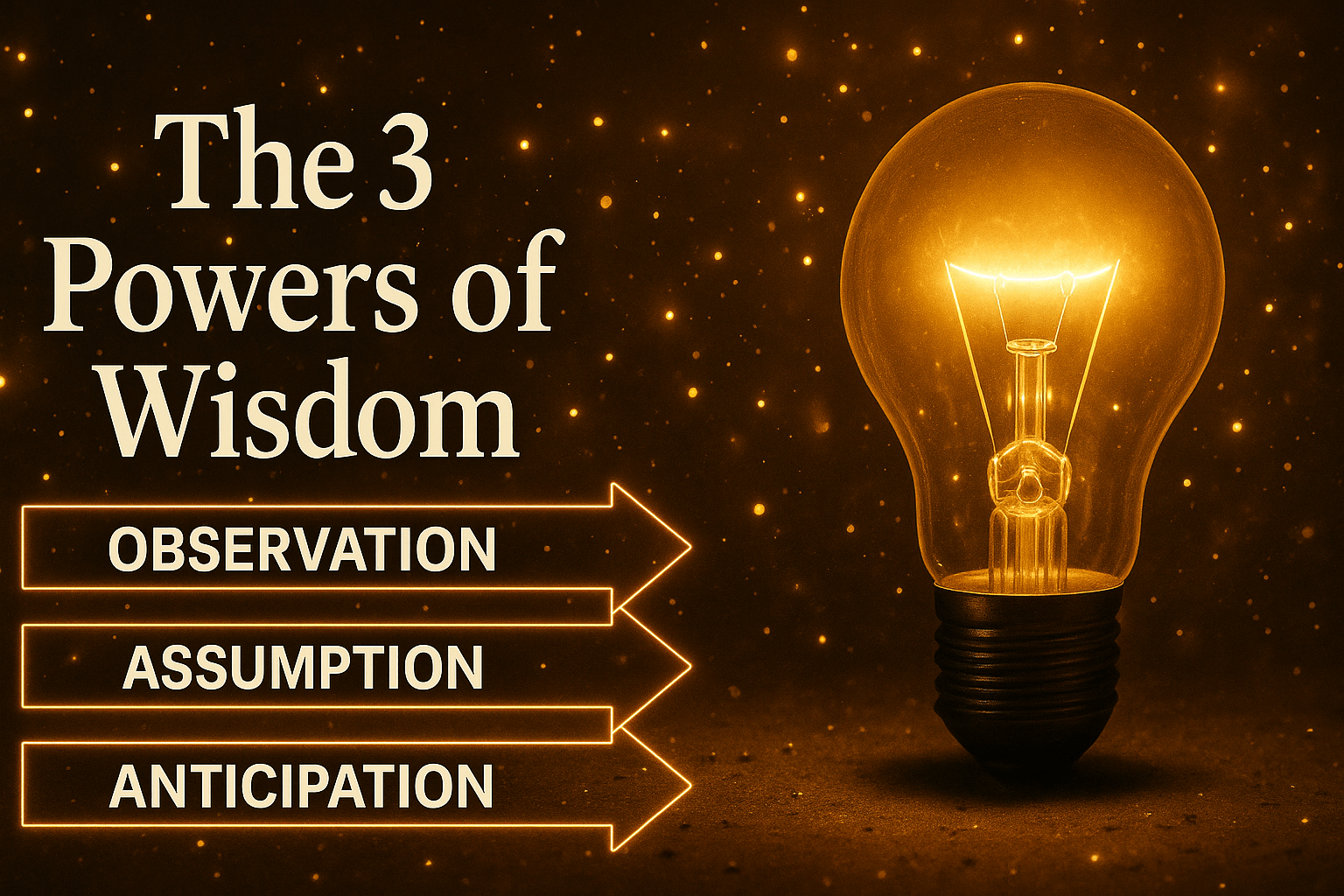
Wisdom goes beyond formal knowledge. It’s a deeper understanding gained from life’s experiences, education, and reflection. It is cultivated through the interconnected powers of observation, assumption, and anticipation, each building on the other to guide sound decision-making and purposeful action. These powers are most effective when practiced with humility, which grounds our insights, keeps us open to learning, and strengthens our ability to grow both personally and professionally.
Wisdom is not merely knowledge acquired through books or formal education. It’s the deep understanding that emerges from the intersection of education, work experience, and life’s countless lessons. True wisdom develops over time as we navigate challenges, celebrate victories, and reflect on our journey. While many consider wisdom an elusive quality reserved for the elderly or the exceptionally intelligent, I believe wisdom is accessible to everyone through the cultivation of three distinct yet interconnected powers. These three powers of wisdom are observation, assumption, and anticipation. When developed and applied in sequence, they form the foundation of wise decision-making and thoughtful action. Though particularly valuable in business settings, these powers serve anyone seeking to navigate life with greater clarity and purpose.
The first power, observation, is the cornerstone upon which all wisdom is built. Observation involves more than passive seeing. It requires active engagement with our surroundings, attentive listening, and thoughtful consideration of patterns and details others might miss. I still remember my mentor Jeff during my studies in England urging me to truly engage with my environment. He challenged me to observe with intention to notice the details in my surroundings such as the double-glazed windows of homes, the changing colors of the trees, the styles of clothing people wore, and even the kinds of umbrellas they carried. His message was clear, wisdom begins by paying close attention to the world around us, because meaning and insight often lie in what others overlook. For example, observation manifests as market research, customer feedback analysis, and competitive intelligence. A sales manager who carefully observes changing customer preferences can identify emerging trends before competitors, positioning their team for success rather than scrambling to catch up.
When we cultivate strong observational skills, we naturally develop the second power of wisdom, i.e. assumption. Based on our observations, we form educated assumptions about what certain patterns mean and how they might evolve. These are not blind guesses, but reasoned hypotheses grounded in evidence and experience. For instance, assumptions drive product development, strategic planning, and resource allocation. Consider a product manager who observes increasing customer frustration with complex software interfaces. They might assume that simplifying the user experience would increase satisfaction and retention, leading to the development of a more intuitive product that addresses this need.
Observation feeds assumption, and assumption in turn nurtures the third power of wisdom, i.e. anticipation. This is where wisdom truly shines. Anticipation allows us to look beyond the present moment and prepare for future possibilities. It transforms reactive thinking into proactive planning. A business leader who has observed market conditions and made sound assumptions about industry direction can anticipate disruptions, prepare contingency plans, and position their organization to thrive amid change rather than struggle to survive it.
The sequence of these powers matters tremendously. Without careful observation, our assumptions become unfounded and potentially harmful. Without sound assumptions, our anticipation becomes mere speculation. Each power builds upon and strengthens the previous one, creating a virtuous cycle that deepens wisdom over time. Skipping steps in this sequence often leads to poor decisions and missed opportunities. The executive who jumps straight to anticipation without proper observation and assumption may lead their company down a path disconnected from market realities.
As we reach towards the end of this article, I would like to reward those who have journeyed with me to this point. I offer you a reward which is the recognition of a bonus power that enhances all others. This fourth power is humility. Humility in wisdom means acknowledging that our observations may be incomplete, our assumptions may require adjustment, and our anticipations may not always materialize as expected. For employees, humility creates space for continuous learning, fosters collaboration rather than competition, and builds trust with colleagues and leaders. The humble employee remains open to feedback, shares credit generously, and approaches challenges with curiosity rather than certainty. This openness to growth and willingness to learn from others ultimately strengthens all three primary powers of wisdom.
As you apply these powers in your professional and personal life, remember that wisdom is not a destination but a journey. By observing attentively, forming thoughtful assumptions, anticipating possibilities, and approaching all three with humility, you transform everyday experiences into stepping stones toward greater wisdom. The path is available to all who choose to walk it.
 Naser Alhemeiri Blog